

Supervision

Welcome.
If you are here, you are likely a colleague — wherever you may be in your professional journey. I would like to begin by thanking you for the care and dedication you bring to your work with clients. Supporting others in their mental and emotional well-being is both meaningful and demanding, and it requires ongoing self-care, reflection, and growth.
Clinical supervision is an essential part of that process. It offers a space not only for learning, but for reflecting, questioning, and deepening your work over time. Whether you are at the beginning of your practice or have many years of experience, supervision can support you in developing clarity, confidence, and a way of working that feels truly your own.
In my work, I take a collaborative approach. I support colleagues in recognizing and refining their strengths and skills, and discovering their wisdom and unique insights. The aim is not only professional competence, but a grounded and authentic presence in your work as a therapist.
Who this work may be for:
This work may be meaningful for you if you are:
- a Registered Psychotherapist (Qualifying, working with limitations, or fully registered) seeking supervision
- wanting to deepen your clinical thinking and understanding
- navigating complexity, uncertainty, or impasse in your work
- looking for a space to reflect on your role, presence, and decision-making as a therapist
- interested in integrating relational, depth-oriented, or psychospiritual perspectives into your practice
Providing a Professional Foundation
What supervision can support
Clinical reflection & understanding
Without reflection, we go blindly on our way, creating more unintended consequences, and failing to achieve anything useful. (Margaret J. Wheatley)
One of the gifts of being a therapist is the ongoing invitation to learn and grow — about our clients, ourselves, life in general, and the work itself. At times, client issues may resonate with our own questions, and relational dynamics can touch uncomfortable places in us, calling us to deeper exploration of our own inner lives. The therapeutic relationship is one of the most significant factors in meaningful change, and we are – always – a part of that relationship.
Supervision offers a space to reflect more deeply on your client work and your presence within it — to explore patterns, dynamics, and possible directions with greater clarity, and to continue developing a safe and effective use of self (SEUS).
Working with complexity & uncertainty
The quest for certainty blocks the search for meaning. Uncertainty is the very condition to impel man to unfold his powers. (Erich Fromm)
Change is constant — and no matter how long you have been practicing, at some point, something new and unknown will present itself in your work. Our practice evolves alongside our clients and the world we live in, and at times this can bring moments of uncertainty — for us as therapists, and for those we support.
As life becomes increasingly complex, it is natural to encounter moments when clarity is not immediately available, when we may feel unsure, or even lost in our work.
Supervision offers a space to stay with these questions — to explore them from different perspectives and, over time, to develop the professional, and sometimes personal, confidence to navigate them in collaboration with your clients.
Professional growth
& sustainability
Quality is never an accident. It is always the result of intelligent effort. (John Ruskin)
Working in a helping profession can, at times, feel isolating. Without space for reflection and support, the work can become heavy — and over time, this may lead to fatigue and burnout.
Supervision supports the longer arc of your work. By reflecting on your practice with a trusted colleague, exploring your professional interests, and following the organic development of your work, it becomes possible to remain engaged, grounded, and inspired, even in the long run.
Supervision also offers a space to bring questions, challenges, and practical concerns — including changes in your own life that may affect how you work. In this way, it supports thoughtful decision-making and helps you sustain a way of working that remains both viable and meaningful over time.
Relational awareness
Emotional intelligence is your ability to recognize and understand emotions in yourself and others, and your ability to use this awareness to manage your behavior and relationships. (Travis Bradberry)
The therapeutic relationship lies at the heart of psychotherapy. It supports the client’s willingness to explore deeply personal experiences and offers a space in which their ways of relating to others — and to the world — are mirrored in their relationship with the therapist.
Through working intentionally with processes such as projection, transference, and countertransference, these relational patterns can become visible. For this work to be both effective and respectful, it also requires the therapist to develop an honest awareness of their own way of relating.
Supervision brings attention to your presence within this relational field. By reflecting on your responses and experiences in the therapeutic relationship, you become more attuned to the dynamics unfolding in each session, with each client.

Developing your therapeutic voice
A long apprenticeship is the most logical way to success. The only alternative is overnight stardom, but I can’t give you a formula for that. (Chet Atkins)
Psychotherapy engages with the realities of people’s lives — their everyday struggles, deeper wounds, and the influence of their social and relational worlds. Each session brings a unique set of circumstances, while the tools we are trained in are, by necessity, more general in nature.
It is up to the therapist to learn to use those tools based on their unique skills and abilities. Over time, therapists move from applying models toward inhabiting their own way of working — developing a voice that is both grounded and authentic.
Supervision supports this process of integration by offering a space to explore different interventions, reflect on clinical experiences, and learn from them in retrospect. In this way, your way of working becomes more intentional, more embodied, and more your own.
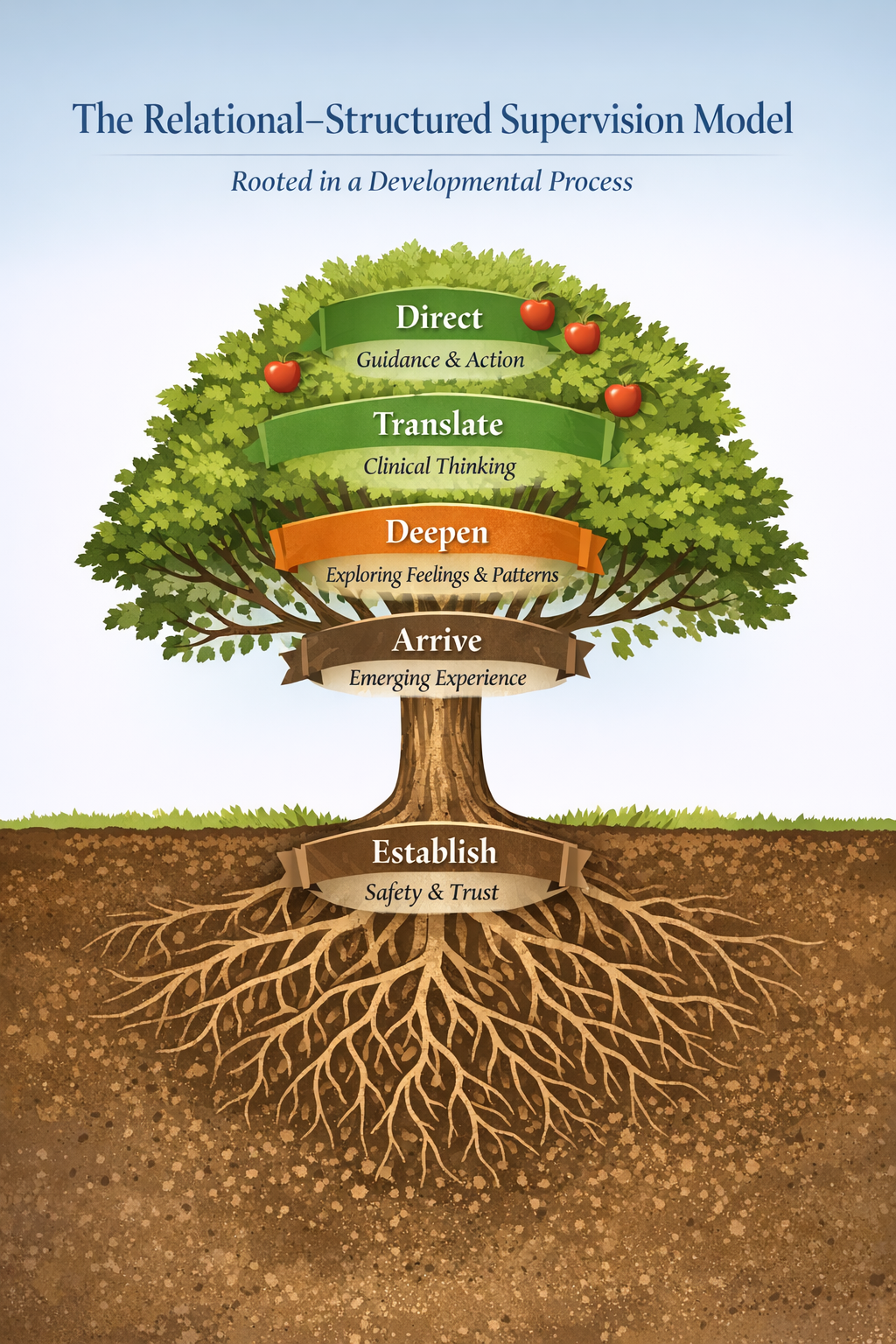
My Approach to Supervision: Relational-Structured Model©
Supervision is an apprenticeship
— an organic and natural development of professional skills and intuition through practical experience and learning.
My approach to supervision is grounded in what I call the Relational-Structured Model — a framework that integrates clear structure with a deep attention to the relational process at the heart of therapeutic work.
Supervision, in this understanding, is both a professional and a relational space. Structure provides orientation: ethical clarity, defined roles, developmental stages, and a coherent process for reflection and feedback. It creates the safety and containment necessary for meaningful learning, especially for those new to the profession. At the same time, the supervisory relationship itself becomes a living field of exploration, where patterns of thinking, relating, and responding can be observed and understood as they unfold.
This model is developmental in nature. Therapists move through different stages of growth, from establishing foundational skills and confidence, to deepening reflective capacity, to integrating their own voice and clinical judgment. Supervision supports this progression by offering both guidance and space — becoming more structured or more open, depending on what is needed at each stage.
Central to this approach is the use of self in therapy. Through careful observation, dialogue, and reflection, supervision helps bring awareness to how you, as a therapist, participate in the therapeutic relationship. Concepts such as parallel process, transference, and countertransference are not treated as abstract ideas, but as lived experiences that can be explored and integrated.
The aim is not to produce one specific way of practicing, but to support the development of a thoughtful, grounded, and responsive practitioner. In this way, supervision becomes a place where structure and relationship work together — allowing clarity, confidence, and clinical depth to emerge over time.
My Part
I see my role primarily as a guide, but at times I can also be a teacher, mentor, consultant, or colleague.
I offer perspective, structure, and guidance, while supporting your capacity to think, reflect, and make decisions independently. I aim to create a space that is both grounded and open, where questions can be explored honestly and without judgment.
Where appropriate, I may offer direct feedback, challenge assumptions, or introduce frameworks that support your clinical thinking and professional development.
Your Part
This work tends to resonate most with therapists who are willing to engage reflectively with their work — to question, to observe, and to remain open to learning.
You do not need to have certainty or all the answers when you come to supervision. Supervision is meant to be a process of learning and exploration in which professional confidence is built.
Supervision is most effective when it is approached as an active, collaborative process. Your engagement, curiosity, and willingness to reflect on your work determine what becomes possible for you.
Individual (Clinical) Supervision
For RP (Qualifying) and those working with limitations while pursuing independent practice
But when one is young; one must see things, gather experience, ideas; enlarge the mind.
Joseph Conrad
One of the most valuable parts of any training is the phase of active learning and gaining practical experience. This is where we learn how to truly be what we have learned to do. This is where theory becomes practice, and we find our own style, our distinct approach, our preferred methods of working. This is also where we make mistakes and learn from them.
Having a place to talk about issues coming up in our work with clients is an important tool for learning how to practice safely, how to approach different situations, and how to best bring our learning and our personal experiences into the work with our clients.
Counter-transference is easily overlooked when we practice in isolation. Transference issues can become challenging when not addressed creatively. Gathering different perspectives on a client’s issue, finding new approaches to a client’s situation expands our understanding of the depth and complexity of our clients’ experiences.
What I offer:
- Individual supervision or dyad supervision with a registered psychotherapist (CRPO #1046)*
- Compliance with current requirements for supervision by the CRPO and several associations
- Dedicated and focused time for reflection and support with client work and related questions
- Collaborative and integrated approach to supervision
- Support in understanding and implementing modalities and approaches
- Report-based, self-reporting supervision
- Supervision agreement formulated based on individual needs and training requirements
- Support in …
- recognizing and formulating your client’s main issues, possible blocks and triggers (projection/transference)
- exploring your own possible blocks and triggers (countertransference)
- developing treatment strategies
- choosing appropriate interventions and tools
- examining possible biases
- establishing appropriate professional boundaries
- and more
Individual sessions are offered in half-hour increments online, by appointment only (phone sessions are possible in special circumstances).
Group work can be part of our supervisory relationship. However, since group work doesn’t allow for the in-depth knowledge required for effective supervision, some individual sessions have to be scheduled alongside group.
Supervision is based on an individual contract that outlines…
- number of supervision hours requested
- duration of our supervisory relationship
- frequency of supervision meetings
- special areas of attention if required
- style and methods of your practice
- approach and style of supervision
- frequency and format of feedback
- etc.
The details of this agreement will be discussed and formulated at the beginning of our supervisory relationship and revisited frequently.
In alignment with my therapeutic practice, I offer a first meeting of approximately 15 minutes free of charge. This is NOT a supervision meeting but an opportunity to get to know each other and determine if your supervision goals and my requirements create a good fit for the work.
For RPs in independent practice
Having a place to talk about issues coming up in your client’s work is a valuable and important tool to practice safely, whether you are just starting in your independent practice or have been in private practice for many years.
Counter-transference is easily overlooked when we practice in isolation. Transference issues can become challenging when not addressed creatively. And sometimes we just need a different perspective on a client’s issue or a possible approach to a client’s situation.
Individual clinical supervision offers dedicated and focused time for reflection and support with your client work and related questions. Sessions are offered in half-hour increments online, by appointment only.
- You decide when to book an appointment
- Self-reporting – no need to write separate reports or report on every client
- Support with the implementation of new tools or the exploration of new approaches
-
Open-ended book as you need agreement
- Consultation on clinical or business issues by a peer and registered psychotherapist (CRPO #1046)
In alignment with my therapeutic practice, I offer a first meeting of approximately 15 minutes free of charge. This is an opportunity to get to know each other and to decide if ours is a good fit.
Dyadic (Clinical) Supervision
Working with peers is powerful as it allows us to see ourselves mirrored in others. Supervision dyads (supervision sessions for two supervisees with one supervisor) for therapists in training and those not yet in independent practice offer participants an opportunity to share and discuss problems, concerns, and blocks in their therapy work in the relative privacy of a small group-like setting, while giving them the one-on-one attention that can be so important to developing proper understanding of one’s own therapeutic work.
Dyads for supervision facilitated and directed by an experienced psychotherapist offer the best of both worlds:
- direct, personal, one-on-one attention to details in client work and safe use and understanding of self in the therapeutic relationship
- mirroring and feedback from the other participant
- connection to and learning from another therapist, a peer with similar training and interests
- an affordable way of getting supervision without having to wait a month for a group supervision meeting
Dyads are acknowledged as a form of clinical supervision by CRPO. Participants are encouraged to support each other through creative feedback and respectful and constructive criticism where appropriate. If serious practice issues for one participant become apparent during a dyad session, I may ask that participant to book an individual supervision session with me or another supervisor or to connect with their personal therapist (e.g. in case of serious counter-transference issues).
As dyads are considered clinical supervision, I only accept those supervisees into them who are in a primary supervisory relationship with me. I keep a list of interested therapists from which you can choose a dyad partner when you are ready to book. Dyads don’t have to be static, i.e., with the same partner at every meeting – but they can be. It is your choice.
Supervision with me is self-reporting. This means participants are asked to come to sessions prepared with notes on and records of their client sessions and follow-up reports regarding input from previous sessions.
Dyad sessions can be booked for one hour or longer, e.g., two hours. Dyad sessions are held online.
Group Supervision
Supervision of Supervision
Supervision is a skill that, like providing psychotherapy, can be learned and trained. After having completed my training course in supervision (or any other training program) a new supervisor may want to find a skilled colleague to supervise their work. This is supervision of supervision.
I am offering individual, and, if available, dyadic supervision-of-supervision sessions to new and seasoned supervisors of Registered Psychotherapists. Sessions are facilitated in the same way as general supervision for seasoned psychotherapists:
- self-reporting
- half-hour or one-hour sessions (one hour for dyadic sessions)
- on an as-needed basis
Business Consultations
Sometimes, the biggest issue we are fighting with in private practice is the administration of that practice. Some common issues that therapists in private practice struggle with are
- marketing and growing the practice
- choosing and implementing a (new) practice management system
- changing or deciding on schedules and fees
- developing effective and efficient communication strategies
- and more
Before I became a psychotherapist, I trained in banking and worked in a variety of businesses. This background enables me to look at business and administrative questions from the perspective of a business owner, and help my colleagues to do the same.
During a business consultation, I can help a therapist to fine-tune their questions, develop meaningful plans or steps to gather necessary information or support for their needs, and consider the pros and cons of their goals and possibly alternatives to them. I may, at times, offer direct advice, but it is understood that the final decision on how to move forward always remains with the therapist.
Business consultations are booked on an as-needed basis and can be booked in half-hour segments. They are conducted online. Please note that consultations are not considered supervision by Revenue Canada, and HST applies to the posted session fees.
Moving forward
Supervision is an ongoing, evolving process — one that develops alongside your work as a therapist.
If you are considering supervision or professional development work, please feel free to reach out. We can explore your needs, your context, and whether this work feels like a good fit for you at this stage of your journey.
Sabine Cox, RP
If you have questions, send me a message – or set up a free first meeting of about 30 minutes, so that we can meet, talk about your goals for your work, and see if we are a good fit for it.
(416) 889-5291
Text messages only.
(The phone is not monitored regularly)
Get in Touch
7 Selby Street, Cookstown, ON, L0L 1L0
By Appointment Only.
sabine@sabinecox.com
Fees and Fine Print
Resources
Blogs, Vlogs, and Essays
Contact
Newsletter Sign-Up