Meet Sabine
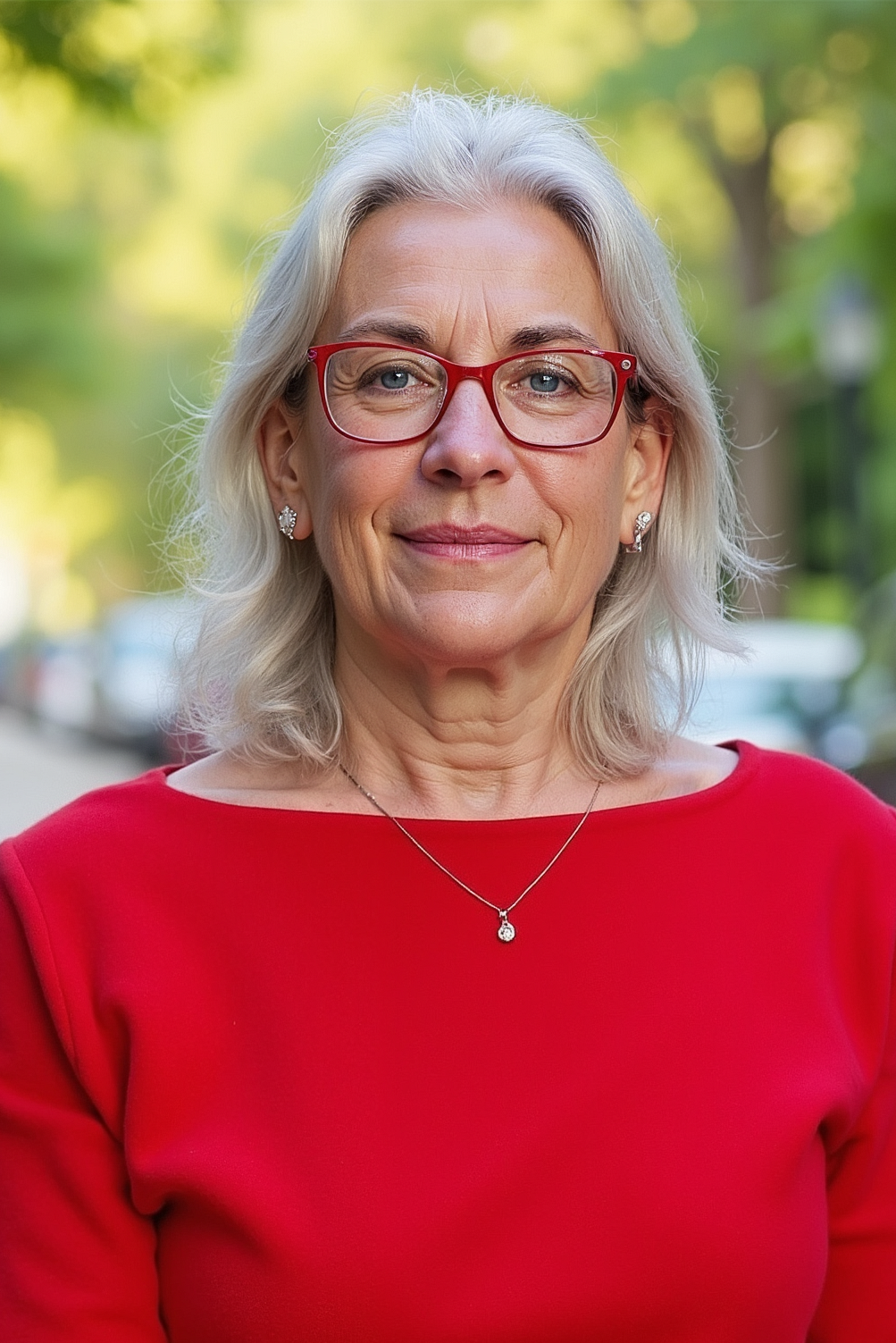
My name is Sabine Cox. I am a Registered Psychotherapist with the College of Registered Psychotherapists of Ontario (CRPO), and I have been working as a spiritual psychotherapist, teacher, clinical supervisor, and counsellor in private practice in Canada since 2000.
My path into this work was not a straight line. I was born and raised in Berlin, Germany, and the social and political realities of the city during my childhood and youth sparked a deep interest in people, history, and the ways our lives are shaped by the world around us. From early on, I was aware of the subtle connections between people and their environments — how inner life and outer circumstances continually influence one another.
My first professional chapter, however, was in business. I trained in banking with a subsidiary of Dresdner Bank in Berlin and then spent about a decade working in private industry. While valuable in many ways, that work gradually led me to ask deeper questions about meaning, purpose, and the human experience.
In the early 1990s, I made a significant life change and moved to Sussex, England, to study human-centred spirituality and spiritual research through anthroposophy. These studies introduced me to educational and therapeutic perspectives that approach the human being from a holistic point of view — recognizing body, soul, and spirit as interconnected aspects of our lives. They also deepened my awareness that our personal experiences are always embedded within a larger context: relationships, culture, nature, and history.
Five years after returning to Berlin, my husband Mike and I moved to Canada. Here, I continued my journey into psychotherapy by enrolling in the Spiritual Psychotherapy program at the Transformational Arts College for Spiritual and Holistic Studies (TAC) in Toronto. Following my graduation in August 2000, I established my private practice while also working part-time in the college’s counselling clinic.
Over the following years, my involvement with TAC grew. In 2004, I joined the faculty of the Spiritual Psychotherapy training program, and in 2005, I began supervising the program’s interns. For two years, I also served as the school’s managing director. In 2010, I stepped away from those roles to focus fully on my own private practice in psychotherapy and supervision.
Since then, I have continued to deepen my clinical skills through ongoing training and study. In 2015, I completed a formal supervision training program with the Ontario Association for Marriage and Family Therapy (OAMFT) in conjunction with the University of Guelph, in response to the supervision standards introduced by the newly formed College of Registered Psychotherapists of Ontario. In 2025, I added the designation of Ontario Validated Clinical Supervisor (OVCS) through the Ontario Association of Mental Health Professionals (OAMHP).
Today, I see clients online and in person at my office in Cookstown, Ontario. I offer psychotherapy for individuals and biographical counselling for couples, as well as clinical supervision for Registered Psychotherapists at all stages of practice. Sessions are typically 50–55 minutes and booked in advance.
During the summer months, I also offer walk-and-talk sessions for those who find movement and nature helpful companions in the therapeutic process.
And I also develop and facilitate courses and workshops for both personal and professional development. You can find out more about that on the Courses & Groups page.
Professional CV
Sabine Cox, RP, OVCS
Registered Psychotherapist • Clinical Supervisor • Educator
Cookstown, Ontario, Canada
Registered with the College of Registered Psychotherapists of Ontario (CRPO), #1046
Ontario Validated Clinical Supervisor (OVCS) – OAMHP
Psychotherapist, supervisor, and educator with more than 25 years of experience in private practice. My work integrates humanistic, transpersonal, and spiritual psychotherapy, combining established therapeutic approaches with holistic perspectives on human development and healing.
Professional Experience
Private Practice – Psychotherapy, Supervision & Professional Education
Cookstown, Ontario (formerly Richmond Hill, Ontario)
2000 – Present
- Individual psychotherapy and couples therapy
- Clinical supervision for psychotherapists (RP and RP Qualifying)
- Professional consultation, including documentation and practice development
- Development and facilitation of professional training programs and personal development courses
Transformational Arts College (TAC) – Toronto, Ontario
Supervisor – Spiritual Psychotherapy Internship Program (2005–2012)
Clinic Counsellor, Teacher and Facilitator (2000–2010)
Managing Director (2005–2007)
Professional Credentials
Registered Psychotherapist (RP) #1046 – CRPO
Ontario Validated Clinical Supervisor (OVCS) – OAMHP, 2025
Education & Professional Training
Association for Anthroposophic Psychology – Foundation in Anthroposophic Psychology
3-Year Certificate Program, 2018–2021
Ontario Association for Marriage and Family Therapy (with University of Guelph)
Fundamentals of Supervision, 2015
Transformational Arts College – Toronto
Diploma in Spiritual Psychotherapy, 1998–2000
Additional Professional Studies
• Biographical Studies with Margli Matthews (2017–2018)
• Certification in Grief Therapy – Breyer University (2005)
• Spiritual Psychology of Fear – School for Spiritual Psychology (1995–1997)
Professional Memberships & Service
Ontario Association of Mental Health Professionals (OAMHP)
Member in Good Standing, 2021 – Present
Ontario Society of Registered Psychotherapists (OSRP)
Member in Good Standing, 2021 – 2026
Canadian Professional Counsellors Association (CPCA)
Member in Good Standing, 2005 – 2021
Volunteer and administrative support to Ontario Chapter, 2007 – 2013
Earlier Background
Prior to entering psychotherapy, I worked in business in Berlin, Germany, and Thornhill, ON, including banking training with Dresdner Bank, serving as Vice President of Teska & Co. GmbH in Germany, and managing director of Hesperus Fellowship in Thornhill.
I also completed Foundation Studies in Anthroposophy at Emerson College, Forest Row, UK (1991–1992).
My Approach to Psychotherapy: Soul-Spirit Integration©
The words soul and spirit carry many meanings across cultures, religions, and philosophies.
I do not claim that my understanding is the only—or even the correct—definition.
It is simply the understanding that has grown out of my own life, studies, and work with clients.
The term Soul–Spirit Integration is one I developed over many years of practice to describe my work and the way I understand both the human being and the process of psychotherapy. It is not a separate school of psychotherapy, nor is it tied to any particular religion or spiritual tradition. Rather, it is an integrative framework that brings together humanistic, psychodynamic, transpersonal, and anthroposophical perspectives in an attempt to understand the person as a whole in the context of their environment.
At its heart lies a simple question:
“What does it mean to become more fully ourselves?”
How I understand psychotherapy
The word psychotherapy comes from the Greek words psyche and therapeia.
Psyche originally referred not only to the mind, but also to the soul, the breath of life, or the invisible animating principle of a human being. Therapeia means to care for, attend to, or serve. In its original sense, psychotherapy can therefore be understood as the care of the soul.
For me, this understanding reaches beyond the treatment of symptoms. It invites us to care for the whole person—not only thoughts and emotions, but also questions of identity, purpose, relationships, values, and belonging.
If psychotherapy is the care of the soul, then it is worth asking:
“What do I mean by soul?”
What I mean by “soul”
In my understanding, soul is the individual experience of the eternal whole, unique in its expression yet inseparable and indistinguishable from the whole. This whole is spirit—ultimately unfathomable in its entirety, which, I sometimes think, is why we come with a soul.
Our souls are what make me, me and you, you.
Soul is how we understand the world.
Just as no two people share the exact same genetic expression, no two people experience life in exactly the same way. Each of us perceives, interprets, feels, loves, fears, creates, and relates through our own unique lens. Soulfulness, therefore, is not about becoming a particular kind of person. It is about expressing ourselves as faithfully as possible through the unique make-up of our own soul.
The difficulty often lies in distinguishing between what we see through the lenses of our souls and what we experience through the filters of our fears and the conditioning we have received throughout life.
One of the central questions in psychotherapy, therefore, becomes:
“Which parts of my life truly express who I am, and which have grown from fear, old wounds, or the expectations of others?”
What I mean by “spirit”
If soul is the personal experience of the whole, then spirit is the whole itself.
Whether we understand that whole in religious, philosophical, ecological, or purely human terms, none of us exists in isolation. We are shaped by our relationships, our families, our communities, our cultures, our history, the natural world, and—for many people—a sense of something greater than our individual lives.
Spirit points toward this larger interconnectedness.
Soul and spirit are therefore not separate realities, but two perspectives on the same existence: one deeply individual, the other universal.
Healing as re-alignment
From this perspective, many forms of emotional suffering can be understood as experiences of disconnection.
Sometimes we lose connection with ourselves. Sometimes with other people. Sometimes with meaning, purpose, or hope. Sometimes with the wider world around us.
Psychotherapy becomes a process of re-alignment.
Rather than asking,
“How do I become someone different?”
we begin asking,
“What is asking to be understood?”
“What part of me wants to change?”
“What part of me already knows the way forward?”
Healing, in this understanding, is not simply the removal of symptoms. It is the gradual restoration of relationships—with ourselves, with others, and with the larger context of our lives.
The individual and the whole
Anthroposophy has contributed an important perspective to my understanding of this process.
It invites us to see the human being not as static, but as continually unfolding throughout life. Childhood, adolescence, partnership, parenthood, work, illness, loss, ageing, and retirement are not simply external events. They are developmental thresholds that ask something new of us and invite us to discover new aspects of ourselves.
Likewise, our biographies are rarely a random collection of experiences. Looking back over a lifetime, themes begin to emerge. Certain questions return. Particular patterns repeat. What once appeared disconnected often reveals itself as part of a larger unfolding.
Our lives do not develop independently from the world around us. Family systems, historical events, cultural narratives, social structures, our relationship with nature, and even just the fact that we are part of humankind at this particular time in history all influence who we become. Likewise, every change we make within ourselves influences the people and environments around us.
By turning inward, we become more capable of engaging the world. By engaging the world consciously, we continue discovering ourselves.
How this shapes my work
This philosophy influences every aspect of my work as a psychotherapist.
My foundation is person-centred and humanistic. Like Carl Rogers, I believe that every person possesses an innate movement toward growth, integration, and self-actualization. Because every person’s path is unique, therapy cannot follow a predetermined formula. The process must grow from the client’s own experience and understanding of the world.
Psychodynamic and anthroposophic thinking help explore how earlier experiences continue to shape present patterns of thinking, feeling, and relating. Becoming aware of these patterns creates the freedom to respond differently.
My transpersonal orientation recognizes that many people also experience questions of meaning, spirituality, purpose, and belonging as inseparable from their psychological lives. These dimensions are welcome in therapy whenever and however they are meaningful for the client, but they are never assumed or imposed.
Why I work integratively
Every client brings a different story.
Some people process experience primarily through conversation. Others connect more easily through body awareness, dreams, imagery, movement, creativity, or symbolic exploration. No single therapeutic approach can fully honour every person’s way of understanding themselves.
For that reason, I work integratively, drawing from a variety of therapeutic approaches and practices, including:
Listening through conversation
- Unconditional, non-judgemental listening — creating a space where your experience can unfold without needing to be defended or explained.
- Reflective conversation — exploring your thoughts, feelings, and life story together.
- Biography work — discovering recurring themes and meaning within the unfolding of your life.
Listening through the body and imagination
- Body awareness — noticing what the body may already know before words arrive.
- Guided imagery — exploring inner images that offer fresh perspectives.
- Dream work — listening to the symbolic language of the unconscious.
Listening through creativity
- Drawing and colour work — giving shape to experiences that are difficult to express in words.
- Gestalt and experiential work — using movement, space, and lived experience to deepen understanding.
- Voice dialogue and archetypal exploration — becoming curious about the different inner voices and patterns that influence your life.
Listening through contemplation
- Mindfulness, meditation, and contemplation — cultivating awareness, presence, and inner stillness.
- Energy awareness — exploring the subtle ways we experience vitality, balance, and emotional movement.
These are not separate therapies, but different ways of listening to the same person. The method is always secondary to the individual sitting in front of me.
Not every tool is appropriate for every client or every situation. Together, we discover the approaches that best support your own way of understanding and engaging with the therapeutic process.
However, all these tools serve the same end: to help my clients gain deeper mastery of their inborn power and wisdom, and to help them reconnect to their lives as fully as possible.
A wholistic approach to life
Soul–Spirit Integration is a wholistic approach to life.
It acknowledges the influence our personal experiences, emotions, and beliefs have on our lives, our relationships, our general well-being, and our motivation. It also recognizes the influence of our physical environment on our emotional and psychological health.
Going beyond the important recognition of the body–mind connection, Soul–Spirit Integration also takes into account the wider connection of the human being to universal forces, to the living earth, and to humankind as a whole.
Ultimately, Soul–Spirit Integration is not simply a collection of techniques. It is a way of seeing the human being.
It is an invitation to approach ourselves with curiosity rather than judgment; to recognize both our individuality and our interconnectedness; and to trust that beneath even our greatest struggles there remains an essential wholeness that has never been lost.
Psychotherapy, in this understanding, becomes not only a path toward healing but a lifelong practice of becoming more fully ourselves.
Sabine Cox, RP
If you have questions, send me a message - or set up a free first meeting of about 30 minutes, so that we can meet, talk about your goals for your work, and see if we are a good fit for it.
(416) 889-5291
Text messages only.
(The phone is not monitored regularly)
Get in Touch
Fees and Fine Print
Resources
Blogs, Vlogs, and Essays
Contact
Newsletter Sign-Up