
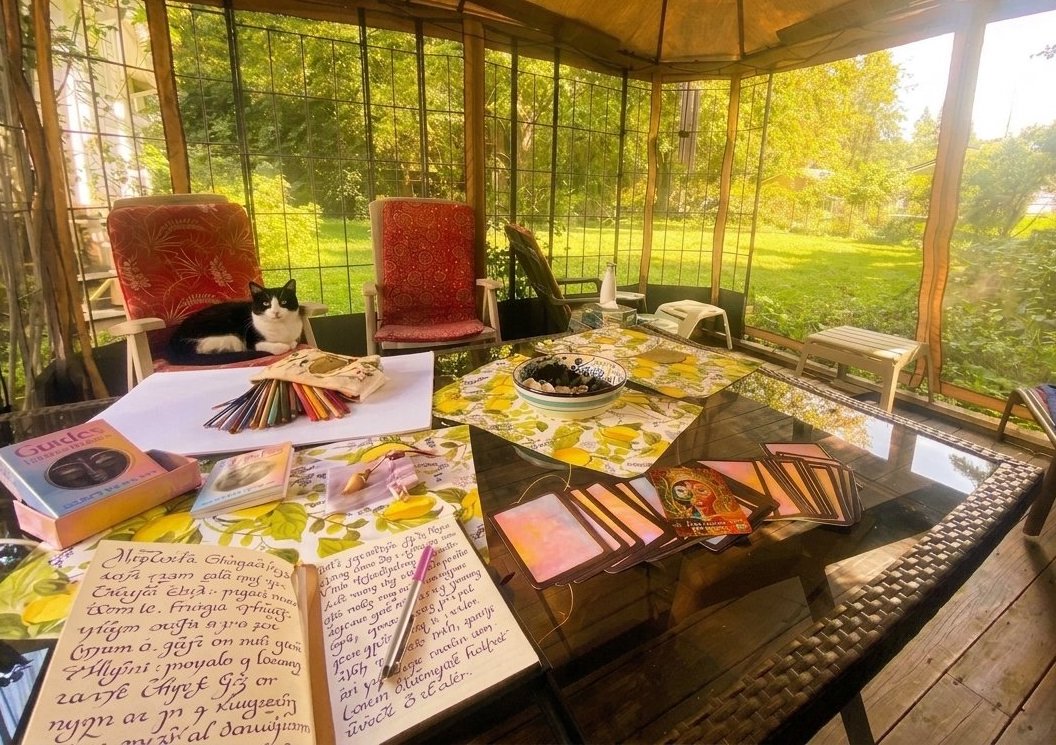
A few weeks back, a friend came over for a Play Day. A Play Day, for us, is a day when we don’t plan, but only follow our bliss – or our fancy, if you’d like. She came prepared with hiking boots and swimsuit, in case that’s where our fancy would take us; I was prepared with art materials and oracle cards. We both had our journals, essential to any proper Play Day.
We started the day with some fruit, home-baked muffins, coffee and tea, and a long chat, catching up. After a while, we found ourselves drawn to the oracle cards. We each did a reading for ourselves, each following their own intuition. We sat in different corners of my gazebo, writing, reading, contemplating, and occasionally calling out something specifically interesting to the other. From the outside, it would have looked like we didn’t engage with each other much at all. But in each of us and between us, we felt deeply connected.
That’s the interesting thing about connection: it isn’t always visible from the outside. We can be deeply connected to someone who is thousands of miles away, and we can be completely disconnected from the person with whom we share a bed. Connection is a soul activity, an affinity of like-mindedness, a feeling of being understood and accepted, and being able to understand and accept the other. Connection is based on openness and curiosity.
Connection is built through respect and ongoing interest in the other person. That is why sometimes we end up feeling disconnected from a partner or old friend: somewhere along the way we lost respect or interest. We aren’t curious anymore. We have become self-focused, need to be right, can’t accept the other with their faults and gifts.
Connection is not the same as infatuation or passion, although often they feel similar, especially in the beginning of a relationship. We are drawn to the newness, the unknown – or the comfortable – in the other person, and we believe that we are connected. But quite often what we are connected to is our own projection of what we want that person to be: the one who gets us out of boredom, who makes us feel safe, beautiful, useful, desired, interesting. Often it is only when the projection gets overpowered by the reality of the real person that we need to choose if we want to build a real connection or if we will keep looking for a better fit for our projection.
Interestingly, we often lose our sense of connection with another when we feel disconnected from ourselves. We project onto others because we don’t feel that we have the power or ability of that specific trait in ourselves. If I feel that I can’t keep myself safe, I project protection onto my friend. If I feel plain, I make my partner the reason for feeling beautiful. If I feel lost, focusing on my family gives me purpose. But in neither case do I connect to who I truly am. Instead of turning inward, I turn outward.
My friend and I, that day in the backyard, both were turned inward. We looked at our lives, our soul questions, and journaled in our own ways. But because we both felt connected to ourselves, and safe in these connections, we could be open to each other. At some point during that afternoon, each of us stopped her own exploration to listen to the other. We shared with each other, gave each other insights and suggestions, and found that somehow what one was working on had a relevance of some kind to the other’s work. Neither of us needed the other to be anyone other than who they were. And in allowing each to be completely themselves, both of us were enriched and seen.
Building this kind of connection with self is possible for most people. It starts with being honest with oneself: What am I really feeling or thinking right now? Why did I do this thing that I feel bad about now? What thought made it feel okay not to act when I was mistreated? Or the deepest question of them all: Who am I right now?
The most important things to remember in such an exploration are self-acceptance and self-compassion. It isn’t helpful to ask why questions with an accusatory tone. They need to be based on curiosity. They ought to lead to a renewed interest in observing and exploring one’s thoughts and behaviours. Much of this we can do on our own. Journaling is a great tool for such an exploration. Mind maps and self-discovery frameworks like Enneagrams, personality tests, or Jungian Archetypes can also be helpful. And sometimes depth therapy can help to unravel particularly knotted patterns and beliefs.
The exploration of self is not always light and easy, but the reward for the work is great: a deeper connection with oneself, an acceptance of one’s humanity, and an openness to others that can lead to deeper – and more playful – connections.
Photo by Sabine Cox with some AI clean-up.